Category: Non-fiction

  • Craft Chat: The Place for Writer Collaboration

    Craft Chat: The Place for Writer Collaboration

    My Collaborative Framework

    I find more inspiration and motivation in writer collaboration than from any other pursuit. Are you one of those writers who agrees?

    Do you feel more in sync with other writers than with, oh, the people at work? Or your accountant? Do you find it easier to brainstorm with folks who don’t scoff at the ideas you come up with? Especially when those ideas might occasionally focus on topics such as the different ways one character can poison another?

    If so, consider joining my membership community and attending Craft Chat meetings. We:

    • Enjoy exchanging ideas and viewpoints
    • Strive to improve our skills and are open to different techniques
    • Work to become better storytellers and/or refine our writing styles and voices
    • Love the synergy of a small, intimate group

    Exclusive Content and Access to Craft Chat

    In addition to the regular posts on my blog, I post exclusive content for my members. For me, it really is all about writer collaboration. At the Craft of Writing level, you’ll find craft tips, videos, how-tos, and information shared by other writers. Recent posts include Birth Order Characteristics and Creating Character Profiles.

    You’ll also find downloadable forms, such as character profile templates. I upload new content on a regular basis, so keep checking back.

    Craft Chat: The Place for Writer Collaboration

    I offer access to monthly Craft Chat meetings to members of my community. They offer a casual but structured environment where  we chat about our craft, the challenges we face, and our continued progress. My hope is for each writer to connect with one or more other attendees, without pressure, to find what he or she needs.

    For more information, watch the quick video that appears above or check out the Membership page on my website. Once you join my membership community (there’s no cost to join), you’ll be taken to your Membership Dashboard. From there, you can access the exclusive content and register for Craft Chat.

  • 3 Research Tips for Writers

    3 Research Tips for Writers

    We’ve all heard that “knowledge is power” and I’m all in when anyone provides research tips for writers. Before the use of technology and the Internet became my primary assistant when conducting research, I spent a LOT of time:

    • In libraries
    • Purchasing and thumbing through books and magazines
    • Conducting face-to-face interviews

    Now, I do the majority of my research online and I’m happy to share 3 research tips for writers:

    Fiction Writers: Naming Characters

    When I create my characters’ names, I prefer them to have meaning tied to the individual character. For example, I know the name Blanche (or Blanca) is entirely inappropriate for a dark-haired woman but perfect for a blonde (or white-haired senior). But that’s only if I’m thinking about her appearance. If I’m thinking about the condition of her soul (as in pure), it would also work … and if I chose it for that reason, I’d probably spell out that her name represented her internal qualities rather than her looks.

    Being an auditory person, I like first and last names to “go” together. To sound right. Alliterative names appeal to me, but sometimes they can be too cutesy or over-the-top (e.g., Debbie Downer, Joan Bone). I like my characters’ first and last names to share at least one consonant (e.g., LiNda McHeNry–which is my real name, by the way) or one obvious vowel sound (e.g., AmY GradY). I also want the number of syllables to sound right. Bartholomew Mountbatten is alliterative but it’s a mouthful. IMO, Bartholomew Bing sounds better.

    Finally, getting ethnicity right is very important. I’ll never forget reading an article written by a bestselling author about this topic (although I can’t remember the writer’s name!). She chose a last name for her Chinese protagonist based on a number of considerations. Problem was: the name she chose was Japanese. None of her beta readers, nor her editor and agent, ever noted this inconsistency. Worse: MANY of her readers did, as evidenced by her [non-]fan mail!

    Here are two websites I find helpful when namng characters:

    • Looking for an age-appropriate name for Grandma or a teenager? The Social Security Administration has tracked the most popular baby names by year of birth. You can find it here (be sure to scroll down far enough): https://www.ssa.gov/OACT/babynames/
    • Looking for a site that lists BOTH first and last names alphabetically AND by ethnicity? This is your new go-to site: https://www.behindthename.com/

    Online Research Tips for Writers

    In no special order, here are important considerations when conducting online research:

    • NEVER rely on a single resource. Why? Because none of us is perfect and none of us knows everything. When relying on sources I find on the Internet, I don’t cite information as a fact unless I’ve verified it by at least 3 sources. My go-to number of sources is usually 5.
    • ALWAYS choose unbiased sources. For example, if I were looking to buy antivirus software for my computer and smartphone, I wouldn’t go to the websites of McAfee or Norton. Why? While each company certainly knows more about its own product than anyone else does, each company is also prejudiced in favor of its own product. When researching anything to do with technology, I rely on sites such as PCMag.com, CNET.com, and TechRadar.com. Why? They’re in the business of writing about and reviewing technology, not manufacturing or selling it.
    • NEVER rely on Wikipedia for facts. On its website, Wikipedia clearly states that just about anyone can write and edit content on the site. I’ve personally researched insurance topics on this website and, in each article I ever read, noted incorrect information. Depending upon the subject matter you’re researching, seek out sources that are unbiased and qualified. If you’re not sure how to do that, simply enter a search phrase such as: best online resources for XXX. In the case of finding an alternative to Wikipedia, you might want to type: best alternative to Wikipedia.

    For all Writers: Validating Sources

    Here’s a list of cautionary advice–make sure that any source you use–online or in person–is reputable and credible.

    • Verify the source’s background and history in connection with the subject at-hand. Most websites contain this information. If a site doesn’t, be wary.
    • Search for reviews and online pieces ABOUT your source.
    • Determine if the source has any bias or personal interest in the subject at-hand. If so, I recommend either disregarding the source or using at least half a dozen sources you know are impartial. Why? It’ll help you see how this one lines up in the scheme of things.
    • If the source provides evidence, facts, or supporting opinions, check them out to be sure they truly exist and are verifiable.
    • Avoid statements presented as facts without any supporting evidence or sources. Do you believe everything you read in a resume, online dating profile, or social media feed? I hope not.
    • Make sure the information you’re using is current. I can’t tell you how many articles I’ve read about the subject of insurance that appear to be current … and were written 10 or 20 years ago. Sure, the content doesn’t use dates, but references to what was going on in the world (like the September 2011 attacks) clearly date the piece and spotlight that the economy referred to in the article has changed.
    • Here’s a Forbes article that offers additional insight: https://www.forbes.com/sites/averyblank/2021/01/19/5-ways-to-identify-reliable-sources-and-maintain-your-credibility/

    Bonus: a Few writerly resources

    In addition to the resources I’ve provided above, here are a few more that you writers might find helpful:

    Keep in mind, I am not related to any of these people/businesses/sites, I’m not paid by them, don’t make payments to them, and I’m simply offering this info out of the kindess of my heart.

    I do subscribe to Writer’s Digest and am a member of The Author’s Guild, Mystery Writers of America, and Romance Writers of America because I benefit from membership in each of them. You may … or may not. Check out the list of major writer’s organizations above if you think one of them might benefit you.

    Feel free to share your favorite resources. Don’t hesitate to reach out if you have any special questions about how I conduct research.

  • Writer’s Block: Unsticking Yourself

    Writer’s Block: Unsticking Yourself

    I’ve found myself stuck on occasion–otherwise known as staring writer’s block in the face. I’ve tried lots of ways to unstick myself, thought I’d found the best, and just discovered the ultimate. Read on and be amazed…

    What being stuck looks like

    For me, writer’s block isn’t the inability to write; I can always write something. The block part comes when I can’t write something GOOD–otherwise known as brilliant, inspiring, or exactly the opposite of the boring, uninspiring trash I just wrote.

    Many years ago, a writer friend of mine (Nancy Harwood Bulk, who has since passed away), gave me some excellent advice. She said that if you hit a snag in your plotting, or you don’t know how your character should respond, make a list of options. And never use the first ten or twenty of them. Her take was that the first things that came to mind would also come to the mind of the reader and, therefore, were a death knell to good fiction.

    I’ve been using that advice for a long time. And, I’m sorry to say, it hasn’t helped me craft the opener my new book. (Which I’m pantsing, by the way. First time for everything.) In the past two weeks, I’ve rewritten the opener about eight times and changed the starting point as many times. I’m nearly bald from ripping my hair out.

    Image by luxstorm from Pixabay

    What getting unstuck looks like

    Because what we writers do when we hit a snag is conduct online research and become embroiled in procrastination, I began searching for creativity tips. Lo and behold, the creativity gods smiled and pointed me in the direction of my latest treasure. In turn, I’m sharing it with you.

    You’re welcome.

    After following this guy’s advice I completely turned around my block and have a TON of excellent ideas to work with … and already started putting them into action. I share the link three paragraphs down.

    My first go-to for any advice about writing is Writer’s Digest and it had some great articles. If you don’t already have a subscription, get one. The online version is much less expensive than the paper/mailed version. I get both.

    I stumbled across several by Jane Friedman, whom I love, which prompted me to visit her website. And that’s where I struck gold. FYI, I don’t know her, never met her, and am not being compensated in any way for this recommendation. She’s just too good not to share.

    Jason Keath wrote an article on her website in October of last year, which I obviously missed. Clearly, Karma knew I’d need it more now than I did then … and that you would too. Bad Ideas for More Creative Writing (https://janefriedman.com/3-bad-ideas-for-more-creative-writing/) contains three different tips:

    • The Bad Idea Method
    • Constraint Questions
    • The Fast & Ugly Draft

    The Bad Idea Method worked for me and is now my new go-to. How do you get unstuck? What do you think of Jason’s ideas?

  • 9 Steps to Achieving Success

    9 Steps to Achieving Success

    You can ask 10 different people what “success” is and you’ll get 10 different answers. However, most people agree about how you arrive at success, the destination, regardless of what your definition of the term is.

    In my 40+ years working in the insurance industry, I’ve made my share of mistakes and learned my share of lessons. I’ve been mentored by some wonderful people and watch a boatload of people succeed. I’ve seen people fail to achieve their desired outcomes, as well.

    Eleven years ago, I made a list of what I believed to be the required elements of success. That list included:

    • Attitude
    • Research
    • Resources
    • Essential knowledge, based on your goal(s)
    • Relationship
    • Organization
    • Time management
    • Money
    • Paying attention to other people

    Some people will tell you luck plays a role in success. And maybe they’re right. But I tend to believe my father’s take on that perspective:

    Why is it that successful people seem to have a lot of good luck? Successful people make their own luck by putting themselves in so many good situations good luck seems to follow them. Ergo: the harder you work, the luckier you are.

    Donald F. McHenry

    I believe a person’s mental attitude and relationships are the two most important elements of success. But I have an opinion about all 9 of those elements.

    The nature of your job, occupation, or profession doesn’t matter. Your tenure at what you do doesn’t matter either–whether you’re a newbie or an expert. What matters is that you can take these 9 components of success and apply them to your job, occupation, profession, or task and accomplish your goals.

    Launching a marketing campaign? They apply to you. Starting a new business. Ditto. The same holds true if you just want a fresh perspective on what you’ve known all along.

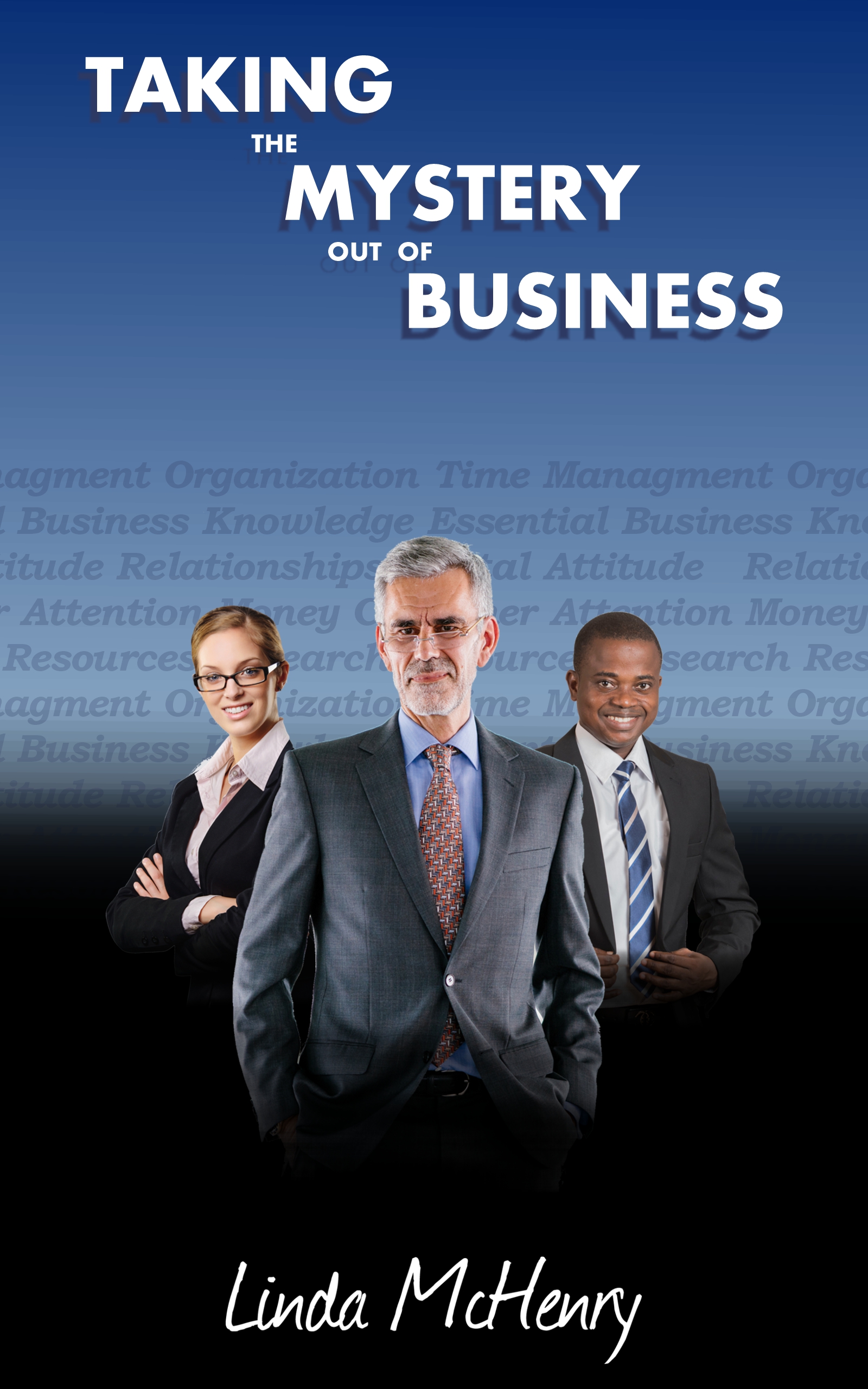
    I discuss these 9 elements of success in my book, Taking the Mystery out of Business. The book is available right now on Amazon in both eBook and paperback.

    What do YOU view as the fundamentals to success?

  • Book Release Date: May 26

    Book Release Date: May 26

    Pre-Order and Save!

    If you pre-order the eBook now, your cost will be $2.99. Beginning May 26, the full price for the eBook will be $3.99.

    Click here to pre-order on Amazon

    Relationships

    People, and how you get along with them, define your professional reputation. Do people like you? Do they trust you? Do they want to refer you to their families and friends? In Chapter Five of Taking the Mystery out of Business, Linda McHenry explains in detail how your sincerity, generosity, and understanding of people create the basis for all your business relationships and demonstrate your degree of professional success.