Category: Business of Writing

  • Writer’s Block: Unsticking Yourself

    Writer’s Block: Unsticking Yourself

    I’ve found myself stuck on occasion–otherwise known as staring writer’s block in the face. I’ve tried lots of ways to unstick myself, thought I’d found the best, and just discovered the ultimate. Read on and be amazed…

    What being stuck looks like

    For me, writer’s block isn’t the inability to write; I can always write something. The block part comes when I can’t write something GOOD–otherwise known as brilliant, inspiring, or exactly the opposite of the boring, uninspiring trash I just wrote.

    Many years ago, a writer friend of mine (Nancy Harwood Bulk, who has since passed away), gave me some excellent advice. She said that if you hit a snag in your plotting, or you don’t know how your character should respond, make a list of options. And never use the first ten or twenty of them. Her take was that the first things that came to mind would also come to the mind of the reader and, therefore, were a death knell to good fiction.

    I’ve been using that advice for a long time. And, I’m sorry to say, it hasn’t helped me craft the opener my new book. (Which I’m pantsing, by the way. First time for everything.) In the past two weeks, I’ve rewritten the opener about eight times and changed the starting point as many times. I’m nearly bald from ripping my hair out.

    Image by luxstorm from Pixabay

    What getting unstuck looks like

    Because what we writers do when we hit a snag is conduct online research and become embroiled in procrastination, I began searching for creativity tips. Lo and behold, the creativity gods smiled and pointed me in the direction of my latest treasure. In turn, I’m sharing it with you.

    You’re welcome.

    After following this guy’s advice I completely turned around my block and have a TON of excellent ideas to work with … and already started putting them into action. I share the link three paragraphs down.

    My first go-to for any advice about writing is Writer’s Digest and it had some great articles. If you don’t already have a subscription, get one. The online version is much less expensive than the paper/mailed version. I get both.

    I stumbled across several by Jane Friedman, whom I love, which prompted me to visit her website. And that’s where I struck gold. FYI, I don’t know her, never met her, and am not being compensated in any way for this recommendation. She’s just too good not to share.

    Jason Keath wrote an article on her website in October of last year, which I obviously missed. Clearly, Karma knew I’d need it more now than I did then … and that you would too. Bad Ideas for More Creative Writing (https://janefriedman.com/3-bad-ideas-for-more-creative-writing/) contains three different tips:

    • The Bad Idea Method
    • Constraint Questions
    • The Fast & Ugly Draft

    The Bad Idea Method worked for me and is now my new go-to. How do you get unstuck? What do you think of Jason’s ideas?

  • 4 Tips for Marketing Yourself … Successfully

    4 Tips for Marketing Yourself … Successfully

    Everyone wants to be successful–that’s why marketing yourself is so important. We also want to make money, be recognized and liked, and sell a lot of whatever it is we’re selling–even if it’s just our good reputation.

    Unfortunately, some of us jump right into marketing without doing our homework. That can lead us to achieve results that are 180 degrees from where we want them to be. Here are a few tips I’ve learned over the years as an insurance agent, public speaker, and professional writer.

    Tip #1: Know and Understand What Marketing Yourself Is … and Is Not

    Marketing is selling and promoting products and services in a market. It’s a process that includes a number of different functions, including but not limited to conducting research, networking, and advertising.

    Social media has made the advertising piece of the puzzle [seemingly] easy. We post on our Facebook timelines, Twitter feeds, and Instagram stories frequently because doing so is easy and fast. Some people, though, overdo it.

    I know that. And so do you.

    Remember, social media is only a very small piece of the marketing pie. If you turn people off with the first bite, they’re not coming back for seconds.

    Example: I’ll bet you’ve hidden people for 30 days from your own Facebook timeline or unfollowed people because they’re constantly bombarding you with their messages. Messages that don’t change–unless you’re counting the modifications to the color scheme or swapping of images in the Canva design. Ever wonder how many people have hidden YOU from their timelines for 30 days?

    Tip #2: It’s all about Your Audience

    Take it from me, people don’t want to be sold. They want to buy. They don’t want to be told what’s good, they want to figure it out for themselves. They especially want to matter to the person who attempts to persuade them what’s good and why they should buy it.

    When you’re marketing yourself, your mission isn’t selling. Your mission is appealing to your audience. It’s matchmaking. Specifically, matching your product or service to an audience member who needs or wants what you’re offering.

    Don’t advertise how great your insurance product is or what a satisfying read your book is. Why? Because that’s what everyone else is doing. Everyone else is talking and people are sick of hearing blah, blah, blah.

    Conduct your research, figure out who wants what you’re selling, and then show those people they matter to you, you care about them, and whatever it is you do will benefit them. Behave in a way that SHOWS them you care. Words are cheap. Actions speak louder. (Pardon the cliches, but they’re true!)

    Sales and marketing is NOT about you. Sales and marketing is about them. And until you put your audience first, you’re going to lose more of those potential clients/customers than you’ll gain.

    Tip #3: Read Dale Carnegie’s “How to Win Friends and Influence People”

    I read this book at least once a year.

    Why? you might be wondering. That book was written in the 1930s and is outdated, you might be thinking.

    Wrong!

    People are the same now as they were then. They might dress differently and have more electronic devices now, but inside they have the same needs and yearnings. Carnegie says there are six ways we can make people like us instantly–and he explains what they are in his book.

    One of those ways is to Always make the other person feel important.

    Why do you think that is? Because feeling important to other people is believed to be the most primal urge in human nature.

    People won’t like you, trust you, buy from you, or pay any attention to you if they aren’t convinced you think they’re important. And don’t kid yourself, people’s instincts are often spot on when it comes to recognizing authenticity, or its lack.

    Tip #4: Be Generous

    Generosity is giving, and giving in a large way. It’s giving with kindness, for the pure joy of making the gift and not expecting or asking for anything in return. Generosity is unselfish and seeks to provide a benefit for someone else and not oneself.

    If, in your marketing, you focus on how you can benefit personally from speaking publicly, or sitting on a panel, or volunteering your time–you’re not really being generous. The focus on you offsets the generosity.

    Instead, if you realize that by being generous and freely offering your time, expertise, or advice without asking for a direct, one-on-one return, that generosity will communicate its true authenticity. Generosity also focuses on the other person.

    I’m not saying to give away the store for free. But I am suggesting you give away pieces of it, judiciously, knowing that by doing so you will (in the long run) benefit tremendously from that generosity. This is the best way to accomplish your goals.

    Conclusion about Marketing Yourself

    Do your research. Understand your audience. And provide what your audience wants–not what you decide your audience needs.

    For more information about marketing yourself and other similar subjects, check out How to Win Friends and Influence People, or any of the many books written by Jeffrey Gitomer, or my book, Taking the Mystery out of Business. You can also watch a recording of my live web class, Marketing Tips for Beginners, on my YouTube channel.

  • Those Email Messages You’re NOT Receiving…

    Those Email Messages You’re NOT Receiving…

    Here’s a quick little lesson to all of you who keep hearing that other people are sending you emails. And resending them. Then sending them again … and, still, those email messages are not appearing in your Inbox!

    Let me tell you WHY you’re not receiving all those emails. They’re going to your Junk folder (which can also be labelled as Spam, Bulk, or something else). And they may be automatically deleted without you even knowing it.

    Fair Warning

    I am not a tech guru, IT nerd, or expert on technology. I am someone who uses email A LOT and have learned lessons the hard way. I’m sharing what I’ve learned, through my own experiences. I’m also sharing a few resources so you can do your own research about those email messages you’re not receiving … and/or that you don’t want to receive…

    Email Security Settings

    Each email app and software includes its own security settings. These settings offer options about how YOU can handle unwanted email, which is referred to as Junk, Spam, or Bulk messages. They also help you receive the email you WANT to receive!

    In many cases, if YOU don’t adjust your Junk settings, the following may automatically be sent to your Junk folder; messages:

    • Sent from someone who is not in your contact list
    • With attachments and/or hyperlinks
    • Sent as part of a bulk emailing
    • Sent by someone who has not emailed you before, or to whom you have not already sent an email

    Junk Email Settings in Outlook and Other Email Apps/Software

    The following images show you what your Junk options are if you use Outlook. You can find them by going to Home > Junk:

    • The image on the left shows the Junk Options
    • The image on the right shows how you can ADD someone into a Safe Sender’s list, meaning the messages from that individual email address or domain will NOT be sent to your Junk folder

    Here are some articles to show you how to set up your Junk settings in:

    A Final Note about Junk Email Messages

    Junk email settings are a lot easier to control when your email address is proprietary rather than free. For example, my email address is associated with my website domain, so I have complete control over it. If you use Gmail, Yahoo, AOL, or any other free email software, you may not have as much freedom to control the settings.

    Be aware that when you open ANY kind of email account the security settings are the default settings used by that app/software. Those settings may not be to your advantage, depending upon your preferences and whether the app/software is free. I’ve heard of settings that automatically delete all Junk mail after a specified period of time (e.g., 72 hours or one week) if the account owner doesn’t change the settings.

    I hope this info is helpful! Reach out to me if I can be of further assistance.

  • Helping Others Helps Yourself

    Helping Others Helps Yourself

    In today’s society, all kinds of crazy things are going on. Instead of isolating ourselves and waiting for Armageddon, we should be pulling together and taking advantage of every positive aspect of our existence. It troubles me that so many of us are unaware that reaching out and helping others helps yourself.

    Today, my job is to enlighten you about how this process can turn around your level of satisfaction and success. I’m focusing on writers and the writer’s life but my advice applies equally to writers, insurance professionals, and everyone else. View my examples as metaphors and then apply them to your own circumstances.

    Let Me Start by Pouring the Foundation:

    • Do unto others.
    • Pay it forward.
    • Help the less fortunate.
    • Volunteer.
    • Do no harm.

    We’ve all heard these and other catchphrases urging us to be a better person. And you know what? They all focus on other people instead of ourselves!

    Frankly, they turn a lot of people off. Why? Because a person’s first reaction is to think that if you’re working on yourself or your writing or anything else that relates to you, why go off-topic and switch the subject from Me to Someone Else?

    Let’s Adjust the Focus as we Begin Building the House:

    When a car drives into a tree, the crash is the direct cause of damage to the car. And the tree. And, more importantly, injury to the driver. The indirect cause of the damage and injury is the dog who ran into the road. Why? Because the dog prompted the driver to yank the wheel and barrel into the tree.

    Life is filled with both direct and indirect causes of loss … and benefits.

    In the publishing world, writers often view their successes based on:

    • How well they know their craft.
    • How accomplished they are at writing proposals, synopses, and queries.
    • How adept they are at gaining the [positive] attention of agents and editors.
    • How many books they sell.

    They sit at their desks, immersed in tunnel vision, only thinking about themselves: Their work in progress. Their editing. Their rewrites. Their deadlines. Their submissions. Their rejections. In short, all the steps they need to follow to achieve their own, personal goals.

    Focusing inward is essential when you’re a writer. The actual writing is, for most of us, a solitary undertaking. Even for those who work with critique partners, beta readers, and mentors, it doesn’t take a village when putting words on paper (or the computer screen).

    However, all goals require a path to follow, and all paths run in two directions–two opposite directions. If focusing inward is heading North, then focusing outward is South. If you’re North, then everyone else is South.

    Understanding the Value of a Sturdy Roof

    None of us enjoys a leaky roof. Drip … drip … drip … will drive you crazy in about thirty seconds. Not to mention the damage that can result from inattention over time.

    You absolutely MUST build a strong roof, nurture and care for it, and update it when necessary. Think of other people as the roof to your personal house. (Pssst: helping others helps yourself.)

    As writers, when we comply with requests from newbies who ask us for advice and insights, we spend X hours of our own precious time educating them without receiving a direct benefit. One perspective is: the newbie doesn’t have publishing contacts. Another way of looking at it is: the newbie doesn’t know as much as we do about craft. Still another viewpoint is: the newbie doesn’t have anything to impart that we really need. Yada yada yada.

    Another perspective is recognizing that each time we share what we know, we’re reinforcing it in our own minds. Each time we explain an element of our craft or the publishing industry, we’re reminding ourselves of something. Often, it’s something we may not have thought about for a while, something we can’t afford to forget. And each time we read or critique someone else’s work, we strengthen our own innate talents and perceptions. Helping others really does help yourself.

    The Artistry of Finish Work

    I don’t know Jane Friedman–I’ve never met her. I don’t know anyone else who knows her–but I’m familiar with her reputation in the publishing world. Between the information she provides on her website and the bazillions of online articles she’s penned and been the subject of, she embodies “helping others helps yourself.”

    Here’s one article on her website about using beta readers that proves my point. The article is written by another person, but it’s on Jane’s website. You can spend all day reading the resources Jane provides on her website without spending a dime. At the same time, you’ll enrich yourself immeasurably.

    My Personal Home

    When I moved to Montana from Massachusetts, the only person I knew in Big Sky Country was my realtor. Nine months later, my circle of acquaintances and friends had expanded. It included about a dozen neighbors and thirty co-workers at the insurance agency where I was employed.

    After I quit my job and established my second insurance agency, I followed my own advice about helping others to help myself. What did I do? I reached out to loan officers, car dealerships, the Chamber of Commerce, and local businesses, etc. I offered my time, knowledge, and expertise. Volunteering on the city’s DUI Task Force was way outside my comfort level; however, it wound up giving me tremendous satisfaction. And and community exposure. Using my sales and marketing experience, I approached the University of Montana’s School of Business Administration with an idea. The Director loved it and, together, we established a networking program that matched graduating college seniors with local businesses looking for interns and new employees. I performed other great and wonderful feats, but I’m guessing you get the picture…

    Decorating Help

    Now, I must admit, I did ask for one small thing in return for the time I offered without compensation. I asked my newfound friends and associates:

    “If you benefit from your interactions with me, would you be kind enough to share your opinion of me–and the fact that I own an insurance agency and am trying to build a new business?”

    That was it. That’s all it took. Sure, I worked hard. But other people–those I helped–worked with me and for me. They actually helped me grow my business and become a more satisfied, successful insurance professional.

    The Open House: Helping Others

    As a writer, I have always followed the same path. I’ve served on the board of several writer’s organizations. I’ve judged hundreds of entries in countless writer’s contests over the years. In one of the writer’s organizations of which I was a member, I created a program called Craft Chat. In each virtual monthly meeting, another published writer and I chatted with unpublished members. We answered their questions about the craft of writing served as a resource.

    They helped me by introducing me to new perspectives, sharing innovative ideas, and enforcing what I already knew,. They also taught me about subjects that never even blipped on my radar.

    Helping others helps yourself. Feel free to reach out to me anytime!

  • Mystery Making with Sisters in Crime New England

    Mystery Making with Sisters in Crime New England

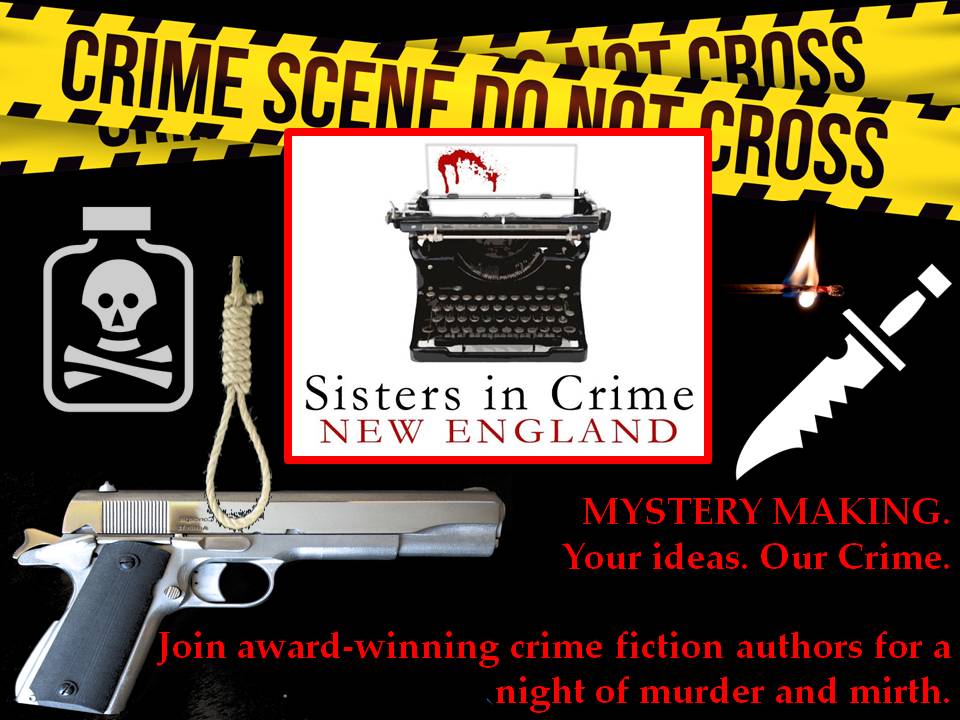
    Advertising the February 10th Mystery Making Event
    Hosted virtually by the Barrington Public Library

    Join my writer friends at me at Mystery Making with Sisters in Crime New England. I am (and have always been) active in a number of writers organizations–and never more so than since joining Sisters in Crime New England (SinCNE).

    Mystery Making is the brain child of SinCNE. It involves a panel of four writers who create a brand-new mystery novel, on the spot. Members of the audience suggest character names and other story elements for us to use.

    In the past, we hosted these events live and in-person, but the virtual events are just as much fun. Join Edith Maxwell, Sarah Smith, Tonya Price, and me on Tuesday, February 10 from 7 to 8 p.m. to plot a mystery!

    Registration ends at 9 a.m. on the day of the event, so register now. Visit the Barrington Public Library for more information or to register.

    Advertising the SinCNE mystery making event on February 10

    The organization lists future events on its website. My next Mystery Making with Sisters in Crime New England takes place on March 6, along with fellow writers Lisa Lieberman, Lorraine Sharma Nelson, and Tonya Price. Join us at the Florida Gulf Coast Sisters in Crime Southwest Florida Reading Festival.