Category: People & Characters

  • Tips for Creating Memorable Fictional Characters

    Tips for Creating Memorable Fictional Characters

    If we writers had crystal balls, we’d have no problem creating memorable fictional characters. Especially when writing short stories and flash fiction.

    But how do I, as a woman, actually know what a guy thinks or feels? Yes, men and women are both human and share many similarities … but, let’s face it, everyone knows they’re different, too.

    In this blog post, I share some of what I learned during the process of co-writing a mystery novel with my friend Herb, and from collecting the opinions of numerous writers over the years.
    Creating Memorable Fictional Characters
    Image by Omar Medina from Pixabay

    Creating Memorable Fictional Characters

    They say to write what you know. But what do I know about being a guy? Or what goes on in the minds of men?

    Another challenge I’ve faced throughout my writing career is to create characters who don’t sound just like me. That challenge is magnified when I’m writing male characters.

    Cowriting with my buddy Herb is, without a doubt, one of the best learning experiences of my writing career. During our collaboration co-authoring a mystery, and throughout the process of critiquing each other’s’ works-in-progress (WIPs), he’s given me insights I wouldn’t have had on my own.

    In short, each of us wrote from the point of view (POV) of specific characters in the book—both male and female. Because each of us has a different background (me with insurance and he with law enforcement and the military), we were able to provide further insight into how our characters would/should behave and talk.

    Quick Quiz

    Can you tell which character (Karl and Stephanie) spoke each of the following lines of dialogu?

    Line 1

    Ed’s boat went down in a storm three days ago. He’s–he’s–gone.”

    Line 2

    Gone? Ed? Three days ago?

    I’ll bet you could. Line 1 is Stephanie and Line 2 is Karl. Read on to learn some of the characteristics that set male and female characters apart.

    Image by 🌸♡💙♡🌸 Julita 🌸♡💙♡🌸 from Pixabay

    The Differences Between Men and Women

    In the controversial but fascinating book, Dangerous Men and Adventurous Women, more than a dozen best-selling romance writers spell out many of the differences they note between men and women. I agree with the perspectives of many of these writers. Specifically, with respect to the manner in which men and women speak, I’ve learned and observed the following generalizations:

    • Although everyone will tell you that women talk more than men do, this isn’t always the case. In fact, a study shows it’s only true in a certain age group.
    • Women ask more questions than men do.
    • Men interrupt more often than women do.
    • Women tend to be specific and men tend to be vague. Just ask a woman and a man what color that dress is. The woman will say mauve and the man will say pink. Or purple.
    • Men are more apt to give orders and women are more apt to make suggestions.

    So, you may be wondering, what does this have to do with creating memorable fictional characters? We need to focus on these differences and incorporate them into our characters’ dialogue and behavior.
    Photo by Susan Holt Simpson on Unsplash

    Devices for Creating Characters

    One tool I’ve found useful is to maintain a spreadsheet or chart of the characters in the story or book I’m writing. In it, I list unique manners of speaking and traits for each character while ensuring that no two characters share the same physical gestures, buzz words, etc.

    In the book I’m writing now, Allie is my lead character. She tends to use long, flowing sentences and think deeply. I don’t allow any other characters to use certain words and phrases that she does, such as:

    • Still, though, given, sure, ditto, yep, nope, nah
    • In fact, no kidding, then again

    Willa, a secondary character, speaks and thinks in shorter, more direct sentences. She’s the only character who uses the following words and phrases:

    • Yes!, despite, now, sweetie, however
    • On the other hand, bit my tongue

    I also make sure that when Allie describes people and objects, and just generally inside her head, she uses words and connections with sound and smell. (She’s auditory.) On the other hand, Willa’s awareness is primarily visual. However, they both have a connection with scent that runs through the story.

    Why Showing Differences is Important

    By using separate and distinct qualities and manners of speaking, it’s easier for the reader to (a) identify which character is speaking, and (b) identify with the character herself. By allowing the characters to share a similar trait, I’m able to subtly build the connection between the two women.

    One of the best strategies I use when writing from a male perspective is to ensure that much of the character’s conversation and internal thought is short and to the point. I’ve found that men tend to use less description in their talk, less reference to emotion, and fewer words.

    Here are some examples from Death Benefits, the book Herb and I wrote together. Note how the male and female characters speak differently. See if you can guess which of us wrote which excerpt.

    Excerpt 1

    “Glad to meet you, Mrs. Tito. Um, Stephanie. I’m Karl, Ed’s friend, and I’m in town now. Is Ed home?”

    “Karl?”

    “Yeah, Karl Stryker. Ed’s Army buddy. I want to come by and shoot the … meet up with Ed.”

    After a long pause, the woman wpoke very softly. “You haven’t heard.”

    “Heard what?”

    “Ed’s boat went down in a storm three days ago. He’s–he’s–gone.”

    “Gone? Ed? Three days ago?”

    Excerpt 2

    Manny pulled a notebook from his jacket pocket. “What does this guy look like?”

    She closed her eyes. “Late thirties? Longish blond hair, blue eyes, and clean-shaven. Moved like an athlete. Had a nice, open smile.”

    He could always count on Ann for the details. “How tall?”

    She opened her eyes and grinned. “Taller than me, shorter than you.”

    “Ann.”

    “My eyes were level with the crooked knot of his tie.”

    Creating Memorable Fictional Characters

    To sum up, here’s a chart that contrasts many of the ways in which men and women behave and speak differently. Of course, these are generalizations and each individual man and woman will behave uniquely.

    MENWOMEN
    Find life to be a competitionFind life to be a cooperative effort
    Socialize with other men to DO things togetherSocialze with other women to talk about their FEELINGS and thoughts
    Make decisions about what they plan to do; seldom offer explanationsSay what they want to do and offer the reasons why
    Make statements (they’re direct) *Ask questions and make suggestions (they’re indirect)
    Body language isn’t always congruent with what they’re thking and feeling (e.g., they’ll avoid eye contact or turn away when emotional)Body language usually congruent with how they’re thiking and feeling (e.g., they’ll cry or talk when emotional)
    Seldom initiate or choose to discuss their emotionsOften enjoy and invite emotional conversation
    Learn how they feel by thinkingLearn how they feel by talking
    Interrupt *Take turns
    Ask questions to obtain details and information *Ask questions to continue talking
    Vague (the color is blue)Specific (the color is indigo)
    Rarely use other people’s names in conversationOften use other people’s names in conversation.

    FYI, I inserted an asterisk [*] in the Male column above to show traits I share with most men. Also, FYI, all the Female traits apply to me!

    Share your thoughts below and/or feel free to add your suggestions for additions to the list!
  • Love is Blind … Yes or No?

    Love is Blind … Yes or No?

    I’ve heard the phrase, “Love is blind,” ever since I was a child. For the novel I’m currently writing, I’m exploring the concept because one of my characters believes that if you really love someone, you’ll do anything for that person.

    When I began crafting my characters and plot, I conducted research on the topic. As always, my research had me recognizing some facts about myself … and feeling much better about some of the dumber relationship mistakes I’ve made.

    So, here’s what a handful of scientists and mental health professionals have to say about whether love is blind.

    It’s All About Brain Chemistry

    When we fall in love (or in lust), our bodies go nuts. Especially our brains. Hormones and brain chemicals conspire to interfere with our common sense. They camouflage what really exists and sometimes prompt us to behave in ways we wouldn’t in the absence of all that romance (or lust).

    Thomas Sherman, a noted biochemist and professor at Georgetown University, has said that romantic love subdues the “neural activity associated with critical social assessment of others.” In other words, love makes us believe our lovers are more virtuous and less weak than other people might believe. Love makes us view our lovers through the lens of positivity rather than negativity.

    And it’s not that we twist negative reality or refuse to see weaknesses. It’s simply that when we see them, we don’t think they’re meaningful. I don’t remember who used the phrase but somewhere in my research one of the authors explained the phenomenon as us wearing rose-colored glasses during the early stages of love instead of magnifying glasses.

    A great example involves how we actually see our lovers. How our minds process the tangibles (cognition) and how reach final conclusions (evaluation). Let’s say Jane is greatly attracted to and loves her boyfriend John. When asked to “rate” his handsomeness in both appearance and attractiveness, she says:

    • His appearance, on a scale of 1 to 10, is a 6
    • His attractiveness, on a scale of 1 to 5, is a 4

    Because Jane loves John more for his intelligence and sense of humor than his looks, she rates him higher than an objective observer would. Others, those who like but are not in love with John, would rate him a 3 or 4 in appearance and 2 in attractiveness.

    Our brains actually shut down their logic receptors when we’re in love, which allows us to focus more on our lovers’ positive qualities than on their negative characteristics. In effect, we’re anesthetized to the behaviors that will drive us nuts later on in the relationship.

    Brain Chemicals Behind the “Love is Blind” Phenomenon

    Brain chemicals affect lust, attraction, and attachment. We’ve all felt lust. It’s our estrogen and testosterone that get that ball rolling.

    Attraction is all about enthusiasm, energy, craving and—sometimes—obsession. Three brain chemicals are responsible for these responses:

    • Dopamine regulates our reward centers, motivation, sense of novelty, and directs our goals.
    • Norepinephrine increases our energy, decreases our appetite, races our hearts, and reduces our need for sleep.
    • Serotonin regulates our mood, sleep, appetite, and cognitive functions. It has a tendency to depress and decrease and is responsible for love-related obsession.

    Scientists and psychologists say that, on average, commitment becomes very important in true love relationships about four years in. Commitment can include monogamy, cohabitation, and/or marriage. At this time, the level of dopamine in the brain drops and is replaced by either oxytocin (in women) or vasopressin (in men).

    • Oxytocin is released during childbirth and breastfeeding. It supports the mother-child bonding, pair bonding, and empathy in women.
    • Vasopressin makes a male want to bond with a mate and is responsible for territorial aggression. It’s what makes many men so protective of their girlfriends, wives, and families. However, in most males who are not interested in or capable of pair bonding, it’s been found they have lower than normal levels of vasopressin.

    Other Factors that Support the Love is Blind Concept

    Sherman has also said that “love begins as a stressor then becomes a buffer against the stress.” Love activates the brain’s reward centers. Cortisol increases one’s awareness which, in turn, offsets the stress response. And, of course, dopamine heightens pleasure.

    We’ve all heard the phrases, “love at first sight,” “the One,” and the “halo effect.” Pesky brain chemicals are the culprits here, as well. Love at first sight is most likely a combination of lust/physical attraction and projection—seeing in others what we’re feeling/thinking ourselves. When we’re looking for our soulmate, that’s who we think we’re seeing in this gorgeous, wonderful person. Voilá: The One. The halo effect, what my mother used to call my rose-colored glasses, is believing someone is wonderful simply because we find them attractive. (Don’t we expect the murderer to be ugly and the leading man to be gorgeous?)

    A Final Word

    In short, it’s biology–nature’s attempt to propagate the species–that set our hormones and brain chemicals in motion when we fall in lust. The emotions of true love are an entirely different matter. Few creatures in the wild mate for life.

    It’s shared experiences that help build love after the brain chemicals fade. And keep in mind: communication and communication styles can either make or break a relationship. The signs of true love and a healthy romantic relationship include:

    • Deep emotional intimacy
    • Trust
    • Mutual support and respect
    • Self-awareness
    • Choosing to love the entire, flawed person
    • A balance between individuality and togetherness
    • Belief that love is a journey and not a destination

    Resources

    Here are links to a couple of articles to get you thinking:

    When I consider the above list, I now know why those past relationships of mine didn’t work. What are your thoughts?

  • Do Lies Come in Different Colors?

    Do Lies Come in Different Colors?

    Today’s burning question is: Do lies come in different colors?

    I discussed this topic in a recent insurance ethics seminar I taught and I’m curious about your opinion. Some of my students indicated white lies are okay and other types of lies are not. What do YOU think?

    Why do we Lie?

    I didn’t know lies came in assorted colors so I asked my students, “What’s the difference between a white lie, a red lie, and a purple lie?”

    A white lie, my students said, is a lie that spares another person’s feelings or doesn’t hurt someone else. That got me thinking about other people’s feelings.

    How can we predict with any accuracy how another person truly feels? Why should we modify our opinions based on our perception of what another person’s feelings might be? Are we truly responsible for how another person feels and responds to the truth?

    Keep in mind that our opinion isn’t necessarily the truth–it’s our belief or perspective. In fact, our opinion often changes over time.

    Sometimes, when people ask us a question, they’re asking for an opinion, not a fact: Do I look fat in this dress?

    There’s no truthful answer to this question because no universal, factual response exists. I may think the dress suits you perfectly and Edna may disagree. If Edna decides to tell a white lie and say No, honey, you look great and save your feelings, she’s not telling HER truth.

    Later on in the evening, after you decided to go to a party wearing the dress Edna likes, what if someone else tells you the dress is too tight and you should have chosen something else to wear? Might Edna’s words still hurt when you realize she told a white lie? Might Edna have spared your feelings by telling HER truth in a mindful manner? Personally, honey, your red dress is the most flattering dress you own. If I were you, I’d wear that instead.

    At other times, when people ask us a question, they want a factual response. Why didn’t you answer the phone last night? There IS a truthful answer to this question. Maybe I didn’t hear the phone ring. If that’s the case, saying so would be a truthful response. But what if I didn’t hear the phone ring because the battery died, I turned the phone off when I got home to avoid your call, or I left it at home when I rented a motel room to fool around with your spouse?

    Not providing the entire truth might be misleading … and an outright lie.

    Do the Colors of Lies Matter?

    But when might it be a “white” lie? If the phone’s battery died and I chose not to charge it because I wanted silence, not providing that information might be considered a white lie. In the other two scenarios, not telling the truth is an outright lie. What color lie would it be? Red, purple, blue?

    Let’s face it, a lie is meant to deceive. When we lie, we distort the truth to protect ourselves, not to spare other people’s feelings.

    It’s easier to tell a white lie and say either “yes” or “no” than produce one or two complete sentences that convey how we truly feel … while also considering the other person’s feelings. It’s also easier to tell other types of lies to prevent the fallout from sharing the truth, whether it’s OUR truth or THE truth.

    In closing, let me share the universal meaning of some colors in the rainbow:

    • Red is the color of passion and energy. It’s also a sign of danger or warning.
    • Yellow is the color of happiness and optimism, however, it’s also a sign of cowardice.
    • Green is the color of nature, harmony, and health and is universally associated with envy.
    • Purple is the color of royalty, spirituality, and imagination. It’s also connected with immaturity and sensitivity.
    • White is the color of purity and innocence, yet it can be indicative of coldness, emptiness, or distance.

    When we lie, even when telling white lies, we do so primarily because of our OWN feelings. Feelings that usually represent the flip side of what is good and positive. So yes, I guess lies do come in different colors.

  • What Writing Community Means to Me

    What Writing Community Means to Me

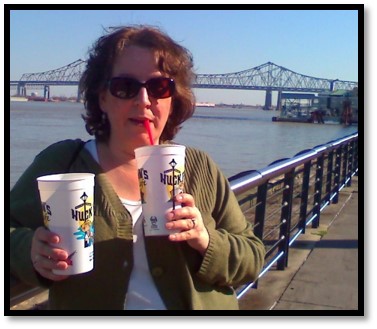
    No, I’m not drinking two beers. One was my sister’s (she’s the photographer) and, in fact, I was drinking a soda. The photo was taken during a writer’s conference where I learned exactly what Writing Community means to me.

    Conferences

    I love going to writers’ conferences. Ironically, the best ones I attended were in New York City with RWA the year one of my daughters turned 11 (she’s never forgiven me for going away). The other two were in New Orleans, one with RWA and one in connection with my award nomination for my first mystery, Second Time Around. (Second Time Around will be re-released early next year.) There’s no greater feeling than the satisfaction of chatting with other writers.

    Groups and Organizations

    I was almost thirty years old before I experienced that feeling. Until I stepped into my first writer’s meeting, I’d always felt just a step out of whack with the world. Certain things would tickle my funny bone in a way no one else understood. I thought my imagination was wonderful thing. Sometimes, other people thought it was scary. Then there was the fact that I couldn’t go anywhere, and I mean anywhere, without a notebook and half a dozen pens.

    Here’s what writing community means to me: The first moment I stepped into the monthly gathering of a group of writers, I knew I wasn’t really a step out of whack with the world. The disconnect I’d been feeling only occurred with people who weren’t writers. The immediate sense of understanding, the way we all looked at life from a quirky perspective, the unique (and often bizarre) senses of humor and imaginations … what a relief to know I wasn’t alone!

    Since then, I’ve felt that same connection with not only writers but also musicians, artists, and those with a creative bent to their minds. It’s the community of writers. We all understand community in the sense of society, social standing, and in business.

    We see that hashtag #writingcommunity all over social media (I’ve been using it a lot lately) and it’s no small thing.

    Fellow Writers

    Recently, I’ve become very involved in a couple of the writer’s groups of which I’ve been a member for years: Sisters in Crime New England and the New England Chapter of Mystery Writers of America. The interaction on Zoom during this pandemic has done a world of good for me. My boyfriend brought this to my attention. He said I seem happier and more engaged with the world. I’ve also become more productive–not only with my writing but with everything.

    So, thank you, my fellow writers. You who have appeared on my podcast, who have welcomed me to your online meetings, who have helped me promote my own books and events. Together, we support each other and can accomplish anything!